
Mastering Number Patterns: A Complete Beginner’s Guide for Kids
Number patterns are one of the most powerful tools for developing early mathematical thinking. Whether it’s simple skip-counting or more advanced arithmetic sequences, understanding patterns helps children strengthen problem-solving skills and build confidence in mathematics.

What Are Number Patterns?
Number patterns are sequences of numbers that follow a specific rule. This rule might involve adding, subtracting, multiplying, dividing, or alternating between operations. Understanding these rules helps children recognize structure, predict what comes next, and see how numbers behave.
Number patterns are commonly taught in grades 1–5 and form the foundation for more advanced concepts such as algebra, functions, and logical reasoning.
Why Number Patterns Matter
Mathematics is a language of structure. When children learn number patterns, they develop:
Logical Thinking: They learn to analyze and predict.
Problem-Solving Skills: They break down complex tasks into simple, repeatable steps.
Arithmetic Fluency: Repeated patterns build strength in addition, subtraction, and multiplication.
Early Algebra Preparation: Patterns are the gateway to understanding variables and equations.
Confidence and Curiosity: Kids become more willing to explore numbers creatively.
Simple Number Pattern Examples
Example 1: Skip Counting Pattern
2, 4, 6, 8, 10
Rule: Add 2 each time.
This teaches children even numbers, doubling skills, and rhythm in counting.
Example 2: Subtraction Pattern
20, 17, 14, 11
Rule: Subtract 3 each time.
This strengthens subtraction fluency and backward counting.
Example 3: Multiplication Pattern
3, 6, 12, 24
Rule: Multiply by 2 each time.
This prepares children for exponential growth concepts.
Example 4: Alternating Pattern
5, 8, 6, 9, 7, 10
Rule: +3, –2, +3, –2…
Alternating patterns promote flexible thinking and attention to detail.
How to Teach Number Patterns Effectively
Tip 1: Start with Concrete Examples
Use real-life sequences:
– Days of the week
– Jump counts (2 steps, 4 steps…)
– Fruit groups
Concrete patterns help children understand abstract rules later.
Tip 2: Identify the Rule Together
Ask guiding questions:
– How much is the number increasing or decreasing?
– Is the pattern repeating?
– Do two operations alternate?
Encouraging students to verbalize the rule deepens comprehension.
Tip 3: Predict the Next Number
Once the rule is identified, have children predict:
– The next number
– The previous number
– The 10th number in the sequence
Prediction builds analytical skills.
Tip 4: Create Their Own Patterns
Allow kids to design unique sequences.
This reinforces mastery and builds creativity in mathematics.
Number Patterns in MathApex
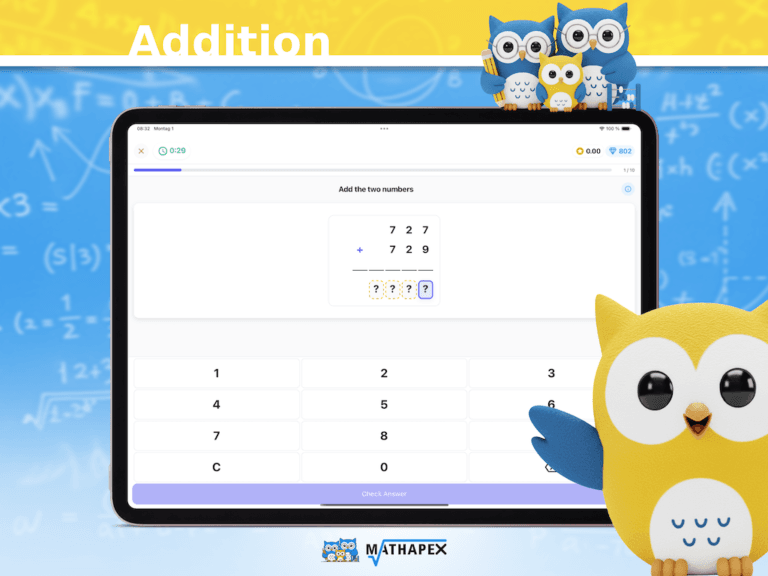
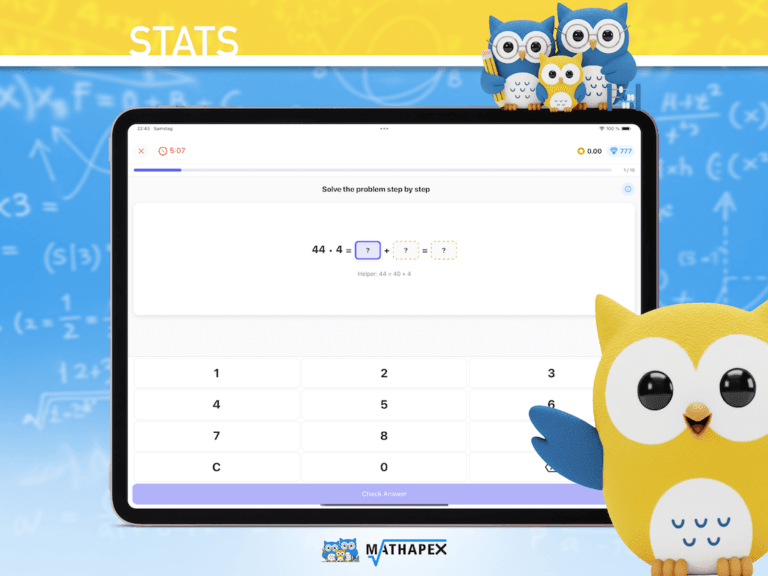
MathApex includes dedicated Number Pattern modules designed for grades 1–5. Children learn through interactive, visually engaging exercises that gradually increase in difficulty.
MathApex offers:
– Dynamic pattern sequences that adjust to the learner’s pace
– Instant feedback and hints for struggling students
– Multi-step reasoning challenges for advanced learners
– A rewards and gamification system to maintain motivation
– Progress tracking for parents and educators
With MathApex, children practice number patterns in a fun, structured, and adaptive environment that aligns with modern learning standards.
Common Challenges and How to Solve Them
Challenge: Children confuse adding with subtracting in mixed patterns
Solution: Start with single-rule patterns and visually highlight increasing vs. decreasing numbers.
Challenge: Difficulty identifying the rule
Solution: Use number lines, color-coded patterns, or manipulatives to make jumps visible.
Challenge: Struggling with prediction
Solution: Encourage children to verbalize the rule before extending the sequence.
Real-World Applications of Number Patterns
Number patterns appear everywhere:
– Music rhythms
– Calendar dates
– Steps in recipes
– Tile and art designs
– Sports scoring sequences
By recognizing patterns in daily life, mathematics becomes more relatable and enjoyable for children.
Practice Makes Perfect
Consistent practice helps children transition from recognizing patterns to mastering more complex sequences. A few minutes per day with structured exercises—whether through MathApex or hands-on worksheets—can significantly strengthen a child’s mathematical foundation.
Ready to Explore Number Patterns?
Help your child build analytical thinking and confidence in math with engaging, interactive learning.
Download MathApex today:
https://apps.apple.com/de/app/mathapex/id6753774905